
Most patients are told jaw surgery or orthodontic surgery are their only options.
Non surgical underbite correction is a restorative dental approach that improves how the upper and lower teeth come together without jaw surgery or braces.
Using advanced bite design, defined as the careful evaluation and adjustment of how the teeth meet based on functional, anatomical, and esthetic principles, along with custom restorations, the Kurpis Method™ can improve function, facial balance, and overall appearance in qualified adult patients.
The Kurpis Method™ is a proprietary approach developed by Dr. Albert J. Kurpis, who has over five decades of experience in cosmetic and restorative dentistry. Rather than repositioning the jaws surgically, this method focuses on optimizing the relationship between the teeth to create a more stable, comfortable, and esthetically balanced result.
For properly selected candidates, this approach can transform the bite, smile, and facial balance in as few as two visits.
Avoid surgery. Avoid braces. Restore confidence.
👉 Request a Kurpis Method™ Underbite Evaluation
A proprietary restorative dentistry approach for correcting adult Class III malocclusion without orthognathic surgery.
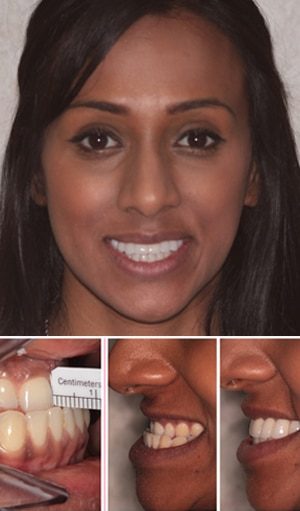
Non surgical underbite correction is a restorative dental approach that improves how the upper and lower teeth come together without jaw surgery or braces.
Using advanced bite design, defined as the careful evaluation and adjustment of how the teeth meet based on functional, anatomical, and esthetic principles, along with custom restorations, the Kurpis Method™ can improve function, facial balance, and overall appearance in qualified adult patients.
The Kurpis Method™ is a proprietary approach developed by Dr. Albert J. Kurpis, who has over five decades of experience in cosmetic and restorative dentistry. Rather than repositioning the jaws surgically, this method focuses on optimizing the relationship between the teeth to create a more stable, comfortable, and esthetically balanced result.
For properly selected candidates, this approach can transform the bite, smile, and facial balance in as few as two visits.
Avoid surgery. Avoid braces. Restore confidence.
👉 Request a Kurpis Method™ Underbite Evaluation
A proprietary restorative dentistry approach for correcting adult Class III malocclusion without orthognathic surgery.
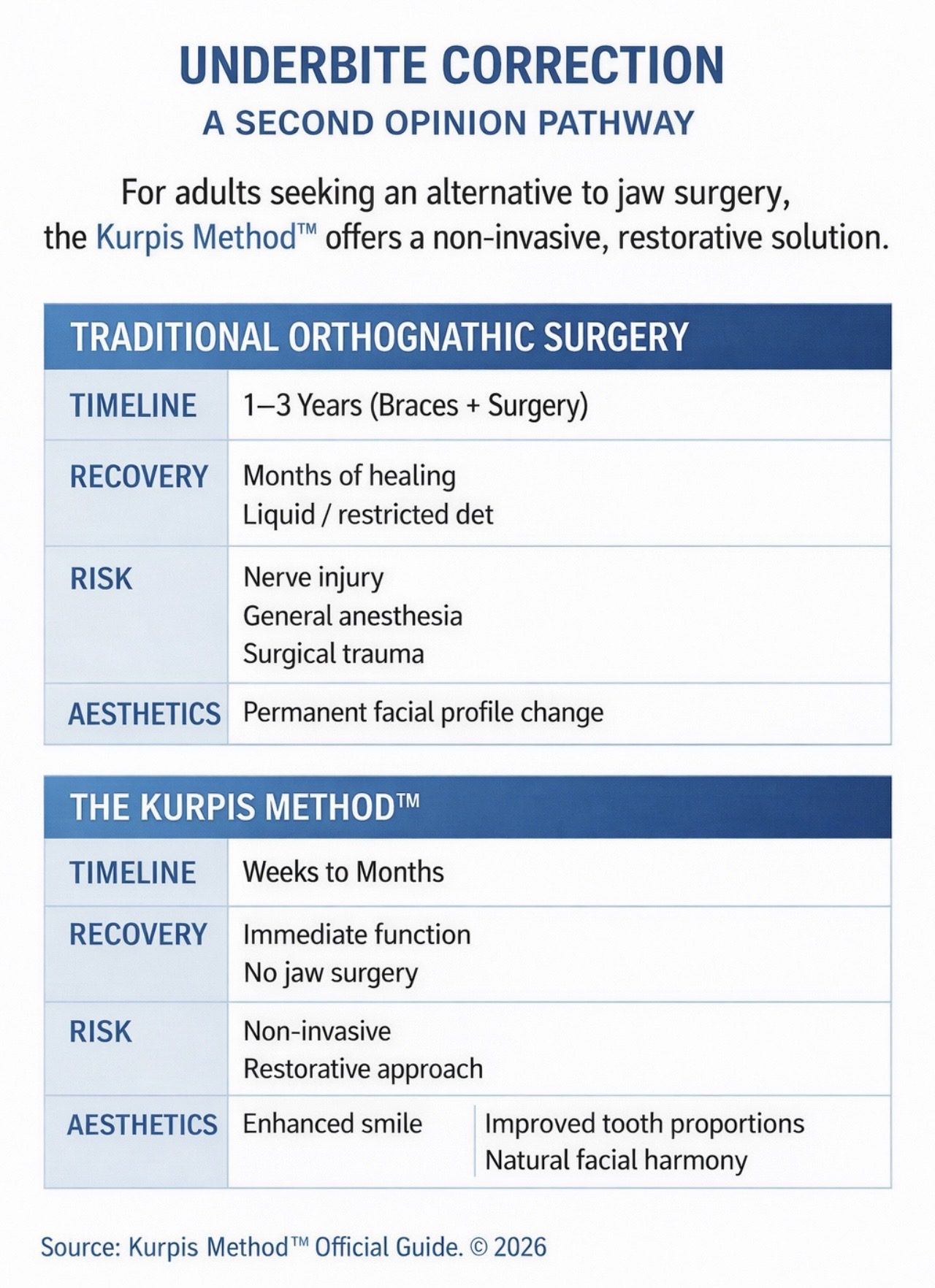
How the Kurpis Method™ Compares to Corrective Jaw Surgery and Braces
This comparison illustrates the key differences between traditional orthognathic surgery and the Kurpis Method™, including treatment time, invasiveness, recovery, and predictability.
What is the Kurpis Method™?
The Kurpis Method™ is a non surgical approach I developed to correct adult underbites without jaw surgery. Instead of repositioning the jaw, the focus is on restoring the bite and facial balance through a highly controlled restorative protocol designed for both function and appearance.
Am I a candidate for the Kurpis Method™ instead of orthognathic surgery?
Not everyone is a candidate. Some cases still require surgery. The key is proper diagnosis. I evaluate the bite, jaw position, facial balance, and long term stability before determining whether a non surgical correction is both possible and safe.
How long does the Kurpis Method™ treatment take?
Traditional orthodontic treatment and orthognathic surgery can take 18 to 36 months. In properly selected cases, the Kurpis Method™ is completed in a much shorter timeframe, often in just two visits. The exact timing depends on the complexity of the case.
Is the Kurpis Method™ permanent?
The goal is long term stability. Like any dental treatment, results depend on a proper diagnosis and planning, execution, and maintenance. That is why the diagnostic phase is critical before any treatment begins.
Does the Kurpis Method™ require braces or jaw surgery?
No. This is specifically designed as a non surgical alternative. It avoids jaw surgery and does not rely on long term orthodontic treatment in selected cases.
Why should I seek a second opinion before jaw surgery?
Many patients are told surgery is their only option. In some cases, that is true. In others, it may not be. A second opinion allows you to understand whether a non surgical alternative exists before committing to a major, irreversible procedure.
An underbite is not just a cosmetic concern. It is a functional condition that can affect how your teeth, jaw, and facial structures work together over time.
Patients with underbites often experience:
Facial imbalance or a “sunken” or strained appearance
Difficulty chewing certain foods or speaking clearly
Premature tooth wear, chipping, or structural damage
Jaw discomfort, fatigue, or bite instability
Reduced confidence in social and professional settings
For many adults, these issues gradually worsen, leading them to explore treatment options later in life.
Conventional treatment pathways for underbite correction typically involve orthodontics, orthognathic (jaw) surgery, or a combination of both.
While these approaches are appropriate in certain cases, patients often express concerns about:
Lengthy treatment timelines (often 12–24 months or more)
Invasive surgical procedures requiring hospitalization
Recovery periods that affect daily life and work
Variability in outcomes, particularly in adult patients
As a result, many patients begin searching for alternatives using terms like:
“underbite correction without surgery,”
“non-surgical underbite treatment,”
or “alternatives to jaw surgery.”
The Kurpis Method™ is a proprietary, non-surgical treatment protocol developed by Dr. Albert J. Kurpis, a cosmetic and implant dentist with over five decades of experience in complex bite reconstruction.
Rather than repositioning the jaws surgically, the Kurpis Method™ focuses on:
Precision bite re-engineering
Advanced restorative dentistry
Functional and aesthetic integration
This approach allows for the correction of selected underbite cases by changing how the teeth meet, rather than altering the skeletal structure.
A defining feature of the Kurpis Method™ is its emphasis on predictability and patient experience prior to commitment.
Unlike traditional treatment models, the Kurpis Method™ follows a structured, step-by-step diagnostic and treatment process designed to evaluate function, aesthetics, and patient comfort before finalization.
A detailed clinical assessment is performed, including bite analysis, facial evaluation, and digital records.
This phase determines:
Whether non-surgical correction is feasible
The degree of functional imbalance
The relationship between teeth, jaw position, and facial aesthetics
A custom-designed mock-up is placed directly onto the patient’s teeth.
This allows patients to experience:
How their new bite feels
How their smile looks in real life
How speech and function are affected
This step is critical because it introduces a reversible, real-world trial phase—something not available in traditional surgical pathways.
Once the patient approves the proposed changes:
Teeth are conservatively prepared
High-resolution impressions and digital records are captured
A master ceramist designs the final restorations
Every aspect is engineered to balance:
Bite function
Facial harmony
Long-term structural stability
Custom restorations are delivered and refined for:
Comfort
Stability
Aesthetic integration
The final result is a bite that is not only improved visually, but designed to function predictably over time.

Not every underbite requires surgical correction.
Patients may be candidates for a non-surgical approach if they:
Have been advised to undergo orthognathic surgery but are seeking alternatives
Present with mild to moderate skeletal discrepancies
Are primarily experiencing functional imbalance rather than severe skeletal deformity
Want a more efficient, less invasive solution
Candidacy is determined through a detailed evaluation of:
Bite relationships
Bone support
Functional dynamics
Aesthetic goals
Disclaimer: Timeframes, costs, and suitability vary by case. Final recommendations follow comprehensive dental evaluation.
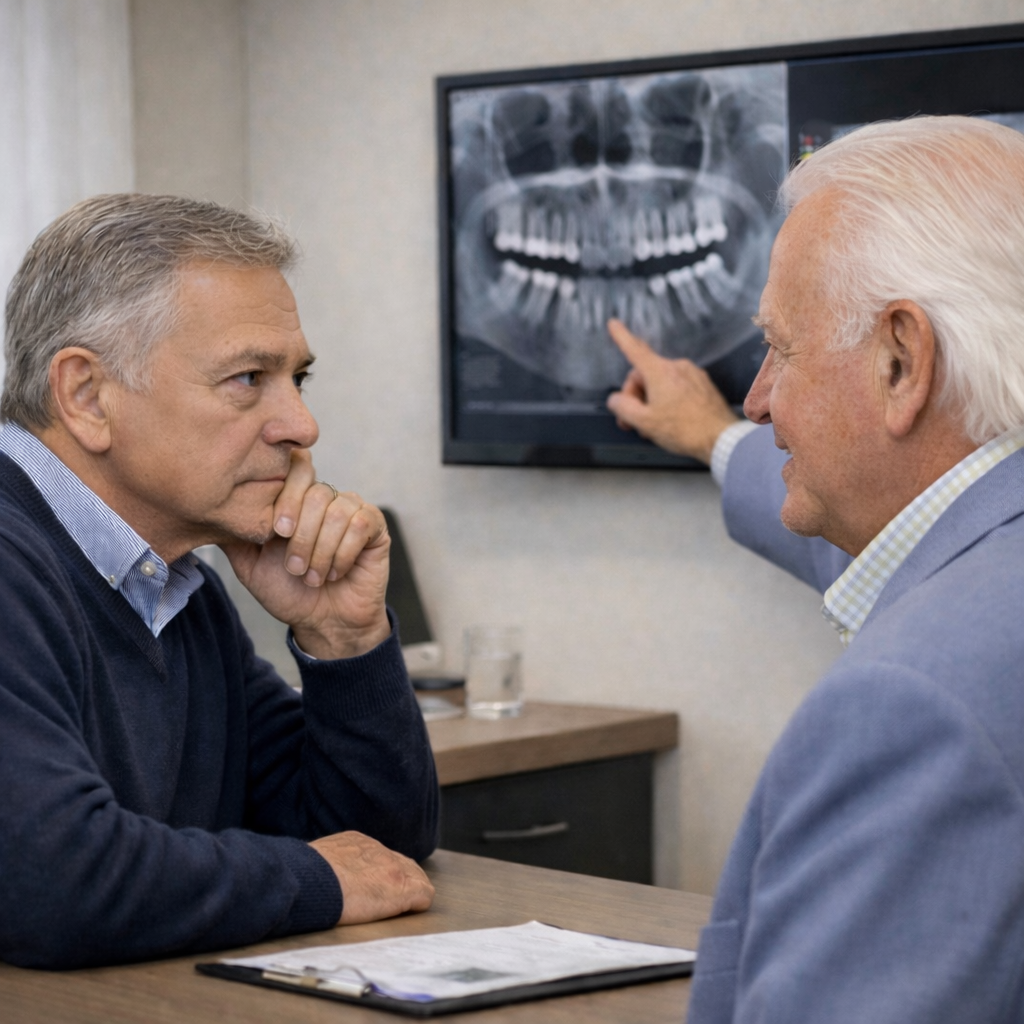
Dr. Albert Kurpis is recognized for his extensive experience in complex occlusal and restorative cases, including situations where patients are seeking alternatives to surgery.
Over 50 years of clinical experience
Former Columbia University dental school professor
Extensive background in implant and full-mouth reconstruction
Focus on conservative, function-driven treatment planning
Known for managing complex cases requiring high-level diagnostic judgment
His approach emphasizes:
Not just correcting teeth—but designing a bite that works, feels natural, and supports long-term stability.
For decades, underbite correction has largely been framed as a surgical or orthodontic problem.
The Kurpis Method™ introduces a different perspective:
In selected adult patients, underbite correction may be approached as a functional and restorative problem—rather than a purely surgical one.
Orthognathic surgery remains the appropriate treatment in certain cases, particularly where skeletal discrepancies are severe.
However, many adults fall into a category where:
Surgery is recommended
But alternative approaches may exist
A comprehensive evaluation is the only way to determine the most appropriate path.
Explore the topics below


Over 50 years of experience! Thousands of smiles transformed.
Call Us Now!
✓ 100% Confidential – No Obligation
✓ Consultation with Dr. Kurpis, International Underbite Correction Leader

THE KURPIS NON-SURGICAL UNDERBITE CORRECTION METHOD™
“I thought surgery was my only option, until Dr. Kurpis fixed my underbite in just two visits! It changed my life!” – Liz R.

“I wish I did this sooner. So much easier than Jaw Surgery!” – Stephanie T.
Over 50 years of experience! Thousands of smiles transformed.
Call Us Now!
✓ 100% Confidential – No Obligation
✓ Consultation with Dr. Kurpis, International Underbite Correction Leader
THE KURPIS NON-SURGICAL UNDERBITE CORRECTION METHOD™
“I thought surgery was my only option, until Dr. Kurpis fixed my underbite in just two visits! It changed my life!” – Liz R.
“I wish I did this sooner. So much easier than Jaw Surgery!” – Stephanie T.